Call us  44 (0)20 7824 7157

20 Grosvenor Gardens, London SW1W 0DH, UK

C-19 Updates

Here you can find shared ideas, resources and inspiration from the INTO family in response to COVID-19

We are thinking of you all as the COVID-19 situation develops on a daily basis.  Like every other organisation, our primary concern is for people who are suffering or on the front line.   And we hope of course that members and supporters of the international national trust family stay safe.

The virus seems to strike at the very heart of the things we particularly value at INTO, like coming together, networking and community. Global connectivity has been blamed. And yet we know from experience that things are better when we work together as a global community.

Below are our latest posts which include some lovely examples from across the INTO network of how our members are engaging their supporters and building support, amid the challenges of closing properties and keeping organisations solvent (particularly Catherine’s Weekly bulletin from 3 April 2020).

Do also check out our special small grants round in support of expenditure incurred during the pandemic.  The deadline for submission is 17 May!

Stay tuned to our social media – and please also tag us in your posts @intoheritage.  Do email us any questions or suggestions, or use our ASK-INTO Google doc to request information and expertise bit.ly/CV19ASKINTO.
A blog by Catherine Leonard, Secretary-General We were delighted to co-host a two-part programme looking at the Asian heritage sector’s response to Covid-19 last week. Read more . . .
A blog by Catherine Leonard, Secretary-General Impact of COVID-19 on heritage sites of the world’s National Trusts Thanks to all of you who have contributed Read more . . .
by David J. Brown, Principal at Bearden Brown LLC Monuments in nature are not always what they seem. Antonio Gaudi, working in Barcelona in the Read more . . .
A blog by Catherine Leonard, Secretary-General This week, we held our quarterly teleconference of the INTO Board of Trustees.  We begin our meetings with a Read more . . .
Heritage tourism is an important cultural and economic activity for virtually all INTO member organisations.  Visitors provide an opportunity for education around the cultural values Read more . . .
A blog by Catherine Leonard, Secretary-General Reciprocal Visiting INTO members participating in our new Reciprocal Visiting Programme are invited to join a discussion on 14 Read more . . .
A blog by Catherine Leonard, Secretary-General This is a short update as Alex has just put together our usual monthly newsletter, which I hope you Read more . . .
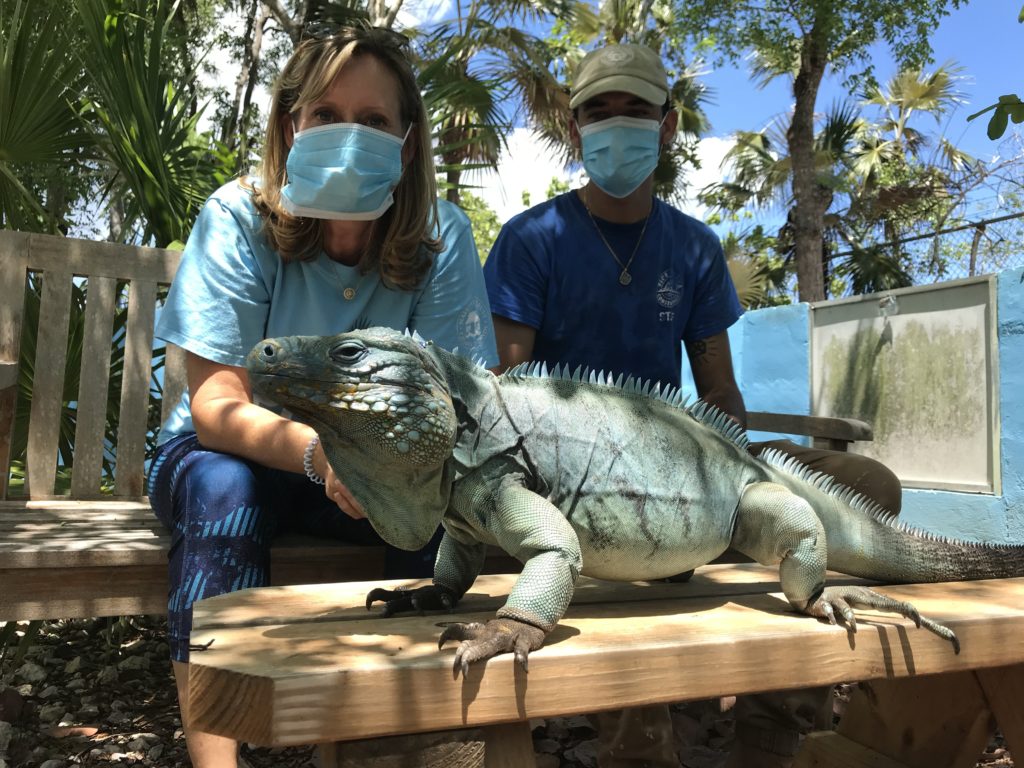
Cayman Islands Covid Grant recipients care for blue iguana
A blog by Catherine Leonard, Secretary-General We’re beginning to process the receipts for our special TAP-INTO grants this week.  Laptops, zoom accounts, cameras, face masks, Read more . . .
A blog by Catherine Leonard, Secretary-General I’ve had some really nice feedback from members about these updates so I’m going to keep sharing them for Read more . . .
A blog by Catherine Leonard, Secretary-General In an effort to keep these updates concise, I am linking again to our round-up of reopening stories on Read more . . .
A blog by Catherine Leonard, Secretary-General It’s Friday again!  And we’ve had another good week at the INTO home offices.  I’ve particularly enjoyed reading the Read more . . .
A blog by Catherine Leonard, Secretary-General So, another week has gone by and I’m here with my Friday update.  In many countries, we’re beginning to Read more . . .
A blog by Catherine Leonard, Secretary-General As usual, I’m sharing a brief update from us here at INTO.   It’s been a week of International Days!  Read more . . .
Digitisation of cultural heritage can be a crucial tool in today’s efforts towards the conservation, study and promotion of European cultural resources. Collaboration with the Read more . . .
A blog by Catherine Leonard, Secretary-General We're all learning how important communicating is at the moment.  Which is probably not the best way to start Read more . . .

And here are some other resources which INTO members might find useful:

From INTO members

  • The US National Trust for Historic Preservation has shared resources for preservationists, museums and historic sites – to keep staff and audiences engaged and involved, but also to connect them to others in the field
  • The National Trust for Canada has shared links to lots of resources here
  • The Heritage Alliance (UK)’s advice hub (this includes general government advice but also a useful digest of statements from organisations across the sector, alongside very specific information like ‘cleaning historic surfaces’)

Fundraising 

Digital

Communications

Governance

A blog by Catherine Leonard, Secretary-General

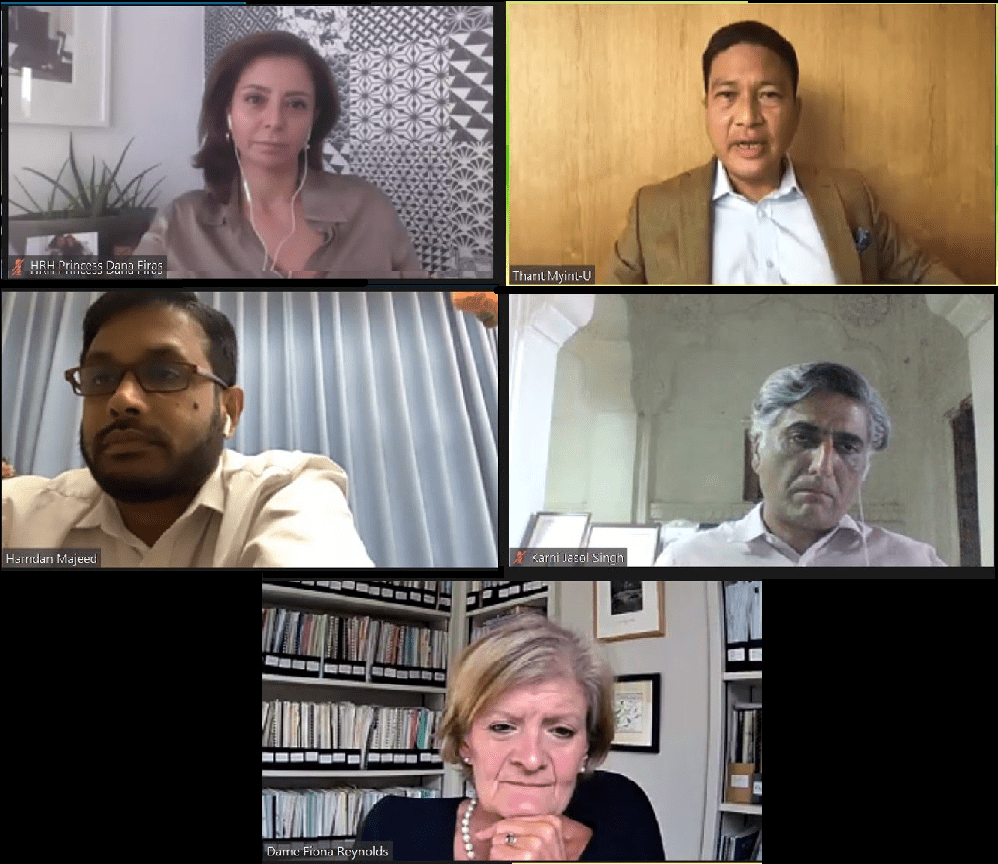
We were delighted to co-host a two-part programme looking at the Asian heritage sector’s response to Covid-19 last week. Working with the Indonesian Heritage Trust and the V&A, we brought together diverse voices to discuss ‘Heritage and Pandemics’.

The themes of ‘Heritage and Pandemics’

As communities across the globe work hard to repair the damage of Covid-19, how can we ensure that heritage plays a role in the rebuilding of places and communities as we move forwards?  What do we need from government and the private sector? And what’s the best way for heritage NGOs to communicate and advocate those needs? What messages do we need to send?

Watch the video below for highlights from the second day, where we were ‘Looking to the Future.’   Our speakers Dr Thant Myint-U, HRH Princess Dana Firas, Karni Singh Jasol and Hamdan Majeed gave insights from across the Asian sector. How might we harness the value of heritage when reimagining thriving and liveable cities in the wake of Covid-19?

If you would like to access a full recording of either session of ‘Heritage and Pandemics’ please contact the INTO Secretariat.

1. Importance of local audiences

Programmes that focus on local communities have been more resilient in the face of Covid-19.

We heard about the wetland restoration work the National Trust of Korea has crowdfunded from local supporters.  Of major sites like Mehrangarh Fort turning their attention towards domestic tourists. From the surrounding area, but also people enjoying road-trips around India.  And of guided walks in Ahmedabad which have been raising people’s awareness of their local heritage.

(We wrote a series of case studies for the Asia-Europe Foundation back in 2012 which featured Ahmedabad.  You can read more about Debashish Nayak’s work with heritage trails to transform Indian cities here.)

2. Heritage is good for your mental health

“Among the people of Jodhpur there is a saying that if they don’t see the Fort once in a day, their day is not complete. This is the level of emotion that people attach to heritage and in these difficult times, when people are feeling under such great pressure, heritage has an important role to play in wellbeing.” – Karni Singh Jasol, Director of Mehrangarh Fort

Through Covid, people have become more aware of their environment and cities need to become more liveable. With better air quality, walkability and access to nature, as we saw at the South Korean eco-park.

(You can find out more about Heritage, Health and Wellbeing in this recently published Heritage Alliance Report.)

https://www.mehrangarh.org/

3. We need government leadership

Many of our speakers talked about the need for government investment in heritage.  Which would be good for the economy, for people’s health and for the environment.

“At a time when governments are thinking about stimulus and economic recovery packages, the right investments [in heritage] made over 2021/22 can have incalculable advantages going forward for decades ahead.” – Thant Myint-U, Founder of the Yangon Heritage Trust

https://www.yangonheritagetrust.org/

Real leadership is needed. Leadership that doesn’t just allow market forces to do their worst.  We heard about changes in government policy in Myanmar to strengthen and extend the demolition moratorium. But also leading by example and finding new uses for empty government real estate in downtown Yangon.

4. But bottom-up approaches work too

“What we have seen in Malaysia is that heritage preservation work started in George Town is beginning to create an impetus for other parts of the country. And this practical, demonstrable experience is now gaining traction at the policy level.” – Hamdan Majeed, Managing Director, Think City

Close collaboration between all the stakeholders – government, entrepreneurs, ngos and the public – can have lasting results. Like how the National Trust of Korea reached a compromise with developers at Cheong-Ju. Their environmental citizenship campaign enabled them to raise awareness and funds. And ultimately to begin making changes to the legal system that will extend the reach of public ownership.

Not all approaches were this successful however and speakers referred to clashes with authorities and developers.  Lastly, a note of caution.  Princess Dana warned that hard-won advances in balancing development and cultural heritage preservation may be reversed. We all need to advocate strongly that governments should not just “switch the development switch back on”.

5. Inspiring leadership can make good things happen

In 2011, a group of architects, historians, businesspeople and others banded together to form the Yangon Heritage Trust in a last-ditch attempt to preserve Yangon’s unique character. Under Thant Myint-U’s inspiring leadership, and utilising his connections into government, the Trust was quickly able to stop demolition in the old city. Since the YHT has continued its important work.  Providing technical assistance to private owners, engaging the public in local history and working with the authorities on urban planning issues.

“Tourism can be part of the economic recover going forward and heritage preservation can be a big part of that. But there is a wider argument to make, as Myanmar is trying to move from a poor country to a middle-income country, having a beautiful city, a liveable city, is a priceless asset. And that preserving and integrating our heritage as part of the future of the city is also a priceless asset for the country going forward.” – Thant Myint-U, Founder of the Yangon Heritage Trust

6. There are strong links between cultural heritage and resilience

Here is an inspirational quote from another inspirational leader.

“If you’re trying to build an inclusive sense of identity, you go back to your cultural heritage. If you’re trying to build public space in which to debate, talk and bring in different perspectives, that can be done through cultural heritage. And if you’re looking for resilience strategies – how communities throughout history have dealt with adversity, how they have adapted, how they have changed – that comes to us through knowledge of our cultural heritage.

And it makes sense economically. Tourism moving forward will be focussed on specifics, on the quality of the experience, on the cultural heritage of the country so it makes perfect economic sense. Any which way you look at it, you have to advocate very strongly for cultural heritage to remain at the top of the agenda and to bring the different parties together so that you are not just talking to the governments. You’re also talking to the private sector and you’re getting support from the local communities themselves.” – Princess Dana Firas, President of the Petra National Trust

http://petranationaltrust.org/

Our next webinar

We are thrilled to be collaborating with the National Trust for Historic Preservation on our next webinar.  It’s called ‘Island Perspectives: Preservation, Sustainability, and the Environment’ and is part of their PastForward digital conference.

From Bermuda, Saint Lucia, Puerto Rico and Haiti, hear how our speakers put sustainability at the heart of their work in an island context. Does caring for natural and cultural heritage together increase impact? Join us to hear from preservation leaders from islands across the Americas as they tell their stories and learn about the challenges and opportunities of working in these unique environments.

There is more information available on our Webinars page.

Island Perspectives Webinar

Additional resources

A blog by Catherine Leonard, Secretary-General

Impact of COVID-19 on heritage sites of the world’s National Trusts

Thanks to all of you who have contributed to our survey of the impact of COVID-19.  The pandemic is straining the financial and programmatic sustainability of many INTO member organisations.  At the same time, you have found new and creative ways to deliver your work and core purpose.

More than half respondents have seen a drop in their membership recruitment and retention.  And while a third receive less than 10% of their annual budget from site-related income, more than a quarter — or 27% — receive at least half of their income from such activities as admissions, rentals, and gifts shops. With visitation down or non-existent during this period, those groups are seeing serious erosion of their fiscal standing since the arrival of the coronavirus.

David Brown, who is undertaking the research, has written a blog summarising the initial findings.  You can read an advance copy of full article here.

And tomorrow we will be sharing it via our usual social media channels, so do please keep an eye on @intoheritage (Instagram, Twitter and Facebook) and repost if you can!

(If you haven’t yet responded to the survey, please do so via this link.  And there is more information about American Express’s support on our website here.)

http://petranationaltrust.org/

Incubator programme

We were so sorry to have to tell our Incubator participants that the programme could not go ahead as planned.  Already rescheduled from March to September, we are sadly still unable to bring everyone together in the UK.  BUT we are planning to digitalise the content instead, which we hope will be equally inspiring!  That also means that we can potentially involve a wider audience and we look forward to telling you more about the online version very shortly.

Reopening webinar

I hope you all receive our monthly newsletter.  Sign up at the bottom of the INTO website if you don’t!   The last issue led with the outcomes of a webinar we hosted on 22 July.  It was an operational discussion between representatives from three European Trusts: the NT (EWNI), FAI (Italy) and the Gelderland Trust in the Netherlands.  The webinar is now available as a podcast that you can access here.   (There is also a written summary we can share if you would like.)

The recording focuses on the experiences of three site managers, Carine van Ketwich Verschuur from Kasteel Doorwerth, Annalisa Filippone of Villa del Balbianello, and Justin Scully at Fountains Abbey.   They talk about what’s been happening, sharing observations and recommendations on what has and has not worked.   It’s a great conversation so do have a listen if you can!

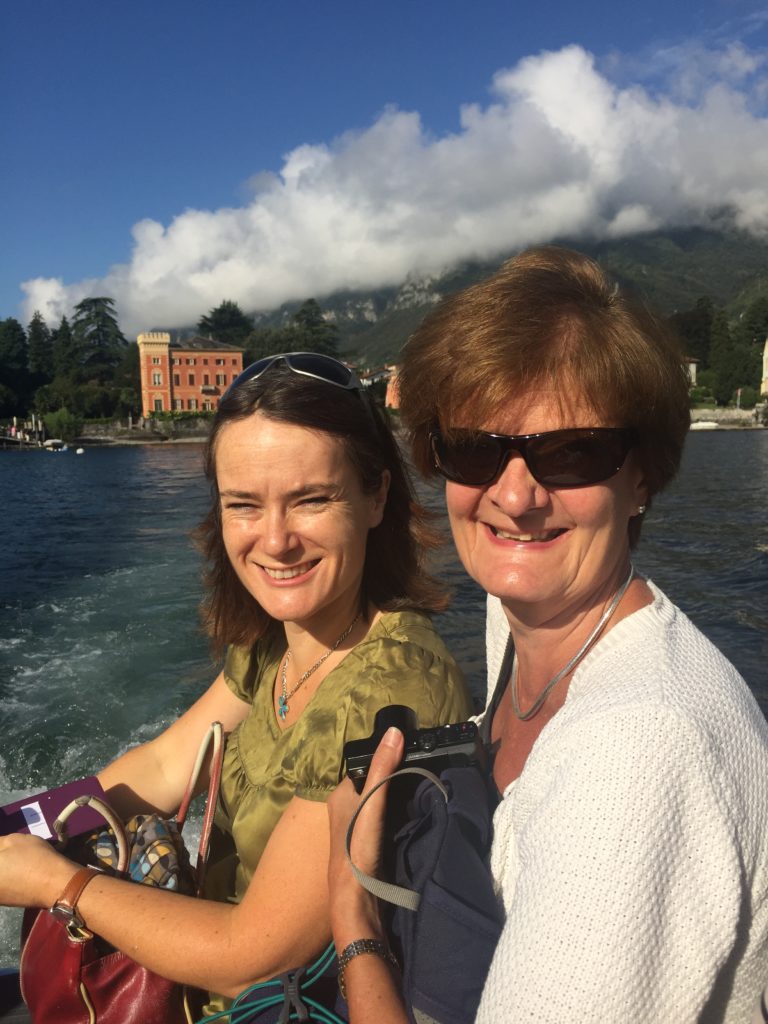
And here’s a sunny picture I took of Dame Helen Ghosh, then Director-General of the NT EWNI and Carine at Doorwerth back in 2015 – and one of me with Dame Fiona Reynolds on the way to Villa Balbienello the following year!

The sun always shines when INTO visits …


by David J. Brown, Principal at Bearden Brown LLC

Monuments in nature are not always what they seem. Antonio Gaudi, working in Barcelona in the early twentieth century, took huge inspiration from the natural environment.  Moreover, his organic architectural style is echoed in his approach to project management. Gaudi was not one to be constrained by accepted norms or rules imposed from above.  Construction of his modernist masterpiece, Casa Milà (known popularly as La Pedrera or ‘the stone quarry’, a reference to its unconventional rough-hewn appearance), was fraught with financial and legal problems.

A monument in nature

Gaudi kept changing his plans as work advanced.  He went well over the expected budget and did not abide by the City Council’s building codes.  The built volume was illegal; the attic and the rooftop exceeded the permitted maximums; and one of the pillars of the façade encroached into the famous avenue, Passeig de Gràcia.  However, after disputes between architect, owners and the city came to a head, district authorities certified that the fanciful building was a ‘monument in nature’ and did not need to conform strictly to the municipal bylaws.

www.lapedrera.com

Now a World Heritage Site, La Pedrera, is just one example of the special places cared for by the global family of National Trusts.  These non-governmental heritage organisations have more than a century of expertise in the preservation and conservation of the world’s treasures.  And over that time have shared nature, beauty and history with local communities and visiting tourists. By focusing equally on outcomes that deliver for the environment and people as well as being economically viable, they have been at the forefront of sustainable tourism efforts.

That work continues, yet COVID-19 has changed the dynamic of heritage tourism in significant ways in 2020.

Survey results

A recent survey conducted by the International National Trusts Organisation (INTO) and supported with funding from American Express, has found that the worldwide COVID-19 pandemic is straining the financial and programmatic sustainability of many of these stewards of our shared global heritage. At the same time, National Trusts have found new and creative ways to ensure that these special places are not another casualty of the global health and financial crises.

La Pedrera is in the care of the Catalunya La Pedrera Foundation. The world-famous Giant’s Causeway in Northern Ireland, is owned by the National Trust in the United Kingdom. And the magnificent archaeology, history, culture, and nature of Petra in Jordan, is protected by the Petra National Trust. All three places, which routinely welcomed a million or more visitors each year in the past, have had to grapple with the impacts of the coronavirus pandemic. Yet all three have reopened, with some restrictions in place, for visitation.

Not all sites have been able to rebound so quickly, however.  And even those which have reopened sites to visitors face further challenges wrought by COVID-19.

Visitor at the Giant’s Causeway, County Antrim

Global family of National Trusts

There are now more than 80 National Trusts, modelled on the original, established 125 years ago.  These organisations and their more than 8 million members span the globe.  From Australia, Bermuda and China all the way through the alphabet to Trinidad and Tobago, Yangon City, and Zimbabwe. They work to ensure the conservation of everything from World Heritage Sites to places of immense significance to their local communities, often with little or no governmental support.

Dame Fiona Reynolds, Master of Emmanuel College and former Director-General of the National Trust in the United Kingdom, is INTO’s Chairman.  She underlines the importance of INTO members’ work: “Beauty, identity, cultural heritage, nature, landscapes – these are the things that make us human. Our organisations stand for these things that bring joy to millions of people. The more people share these values, the more chance there is that protecting our heritage will become integral to our global society’s future.”

Impacts of COVID-19

The INTO survey, taken in July, found that many of these organisations have been significantly impacted by COVID-19.  More than half have seen a drop in their membership recruitment and retention, an important part of ongoing financial support.  And while a third receive less than 10% of their annual budget from site-related income, more than a quarter — or 27% — receive at least half of their income from such activities as admissions, rentals, and gifts shops. With visitation down or non-existent during this period, those groups are seeing serious erosion of their fiscal standing since the arrival of the coronavirus.

Of course, not everyone has experienced the same impacts. As Mohamed Faray Kargbo at the Sierra Leone Monuments and Relics Commission noted, his country has not had the same affects from the pandemic as others around the globe. Yet “the travel restrictions and lockdowns had a serious impact on our heritage sites and museums.” The Monuments and Relics Commission expects that their situation will return to normal over time, but Kargbo adds, “Institutions like ours need to prepare for future pandemics and other global health disasters. We must adapt to the new normal and use online platforms to not only market our sites but also start making income from virtual tours.”

https://mrcsl.org/

Unfortunately, even the largest National Trusts are not immune from the financial impacts of the pandemic. The National Trust for Scotland took a series of emergency measures in May.  These included a significant cut to the workforce, some properties remaining closed until the economy recovers and launching a major fundraising appeal.   In late July, the National Trust of England, Wales and Northern Ireland announced upcoming job losses for some 1,200 full-time staff, or 13% of the current workforce.  Part-time staff will see reductions of 30%.  The Trust is making these changes as a result of an estimated £200 million loss in revenue this year alone. It has already drastically reduced spending, dipped into unrestricted reserves and accessed government furlough, loan, and grant schemes.

Resilience in the times of COVID-19

“We have been careful to ensure that our conservation work is protected with a limit on cuts to jobs that entail caring for houses and collections, gardens, nature and countryside,” noted Justin Albert, National Trust Director for Wales and an INTO Trustee.  “We are confident that we have designed the programme in a way that will allow us to continue to deliver our core mission and ensure visitors to National Trust places continue to have the wonderful experiences they have come to expect from us.”

There are several ways National Trusts are working to address this financial strain on annual budgets. Two-thirds have had to cut non-staff related activities such as programmes, marketing, and overhead expenses, 50% have turned to government grants or loans, while a quarter have relied on staff reductions or furloughs.

Catherine Leonard, Secretary-General of INTO, notes “We’re seeing lots of change across the sector as a result of the pandemic.  Some of this is for the better, like faster ways of working and focusing on what is important. But it has also led to a contraction of programmes and staffing. This is, of course, heart-breaking and we are doing what we can to support the INTO family through the crisis.”  She adds, “The National Trusts of the world are incredibly resilient, and have, over so many years, responded bravely to the needs of the present.  At times like these we really need our National Trusts.  And we also, now more than ever, need them working together across the globe, learning from and helping one another.”

http://petranationaltrust.org/

Heritage tourism

The pandemic hit as interest in history, and the places where history happened, is growing. Before the coronavirus outbreak, visitation to heritage sites was on the rise for many INTO organisations. Two-thirds reported trends of increased visitation in the three years before the pandemic.  And slightly more than a quarter reported annual increases of more than 5% over the past three years. Heritage sites are clearly an attraction to the world’s tourists.

Yet the long-term impact of COVID-19 is unclear for many of these organisations. One survey respondent’s comment that that a bounce back to pre-pandemic levels “depends on commercial air access and quarantine requirements — we may not see any tourists for a long time” reflects the uncertainty faced around the globe in the months ahead.

In a country like the United States, where about 70% of museums and related organisations are history-focused, the sector exerts an enormous economic impact. In an ordinary year, more people go to museums than to major-league sports and theme parks combined. Time magazine recently reported that museums annually “contribute $50 billion to the U.S. economy, boast more than 726,000 jobs and generate $12 billion in tax revenue.”

https://lyndhurst.org/

Katherine Malone-France, Chief Preservation Officer at the National Trust for Historic Preservation and INTO Trustee, said “Heritage sites across the country are tremendously important as community assets that support local economies but they also serve as important touchstones that help define our shared histories, foster truth-telling and reconciliation, and provide places where history and the arts thrive together.”

New ways of working

INTO members are using a variety of tools and methods to connect their work to the public during the pandemic. The most popular include social media posts, opening up landscapes in different ways while keeping buildings closed, and online video tours. But the ways of connecting are a varied as the National Trusts themselves, from online classes for local schools to video chats and webinars with programme staff.

Heritage New Zealand used property staff stuck at home to call ‘about to expire’ members to offer free 3-month extensions and used the time to embed key messages about continued support.  Colleagues at FAI – Fondo Ambiente Italiano (The National Trust for Italy) launched their ItaliaMiManchi (Italy, I miss you) campaign with a focus on local tourism. They used social media to present a different property, at the same time every night. The Trustees of Reservations in Massachusetts put all their farm shops online so that people could order in advance and swing by the farms to pick up groceries.  The National Trust of South Australia streamed live concerts from (closed) historic places, whilst welcoming visitors to their parks and gardens.

Focusing on what really matters

National Trusts have protected monuments in nature — both man-made and those crafted by other hands — through earlier pandemics, world and civil wars, changes in climate, and other threats. They have shared and celebrated stories from our past that have opened new understandings of history and also of who we are today.  Out of the experience stretching over 125 years, National Trusts have found that historic times such as we find ourselves in now generate interest in history. Alongside a real desire to protect those places that are part of our individual and collective memories, and create our community identity, the pandemic provides another opportunity to focus on what matters.

As Director-General of the National Trust in England, Wales and Northern Ireland, Hilary McGrady said when announcing the recent cuts to staff, programmes, and other expenditure due to the coronavirus, “The places and things the National Trust cares for are needed now more than ever, as the nation needs to recuperate and recover its spirit and wellbeing. Our focus will remain on the benefit we deliver to people, every day.” That is a focus that National Trusts across the globe continue to bring to their work.

The author, David J. Brown, Principal at Bearden Brown LLC and a founding trustee of INTO, is undertaking this research project on behalf of INTO with support from American Express.

Further reading

A summary of the results of the July 2020 survey into the impact of COVID-19 on the work of the INTO membership can be downloaded here.

The survey results capture the many ways the world’s National Trusts have responded in the first few months of the pandemic to this unforeseen and tumultuous challenge. While there are certainly many more steps that INTO’s member organisations will have to take in the coming months, especially in certain countries and parts of the world, this snapshot shows a worldwide movement that has moved quickly to ensure ongoing stewardship of the world’s treasures while working hard to protect critical personnel and programmes.

A blog by Catherine Leonard, Secretary-General

This week, we held our quarterly teleconference of the INTO Board of Trustees.  We begin our meetings with a round-up of what’s been going on at everyone’s organisations.   We call this our ‘Learn and share’ and it’s a really nice way to take the temperature of our whole membership, via this representative sample.  So, by way of an update this week, here is what the Trustees shared, but first a quick plug for our next webinar:

Reopening post COVID-19 on 22 July

In this webinar, site managers from three large European trusts reflect on their experience of reopening, with a focus on the practical. How have sites been opened safely? Are visitors keeping their distance? What has been the best way to serve food safely?  We’ll compare and contrast the approaches of our speakers, looking tips that can be applied in National Trusts elsewhere in the world.  The webinar takes place at 3pm current UK time (2pm UTC/GMT) and we invite you to register via our website.

Learn from beautiful Bermuda

William White began our Learn and Share by saying that Bermuda Airport had just reopened, bringing some welcome tourists (although also the first new cases of coronavirus).  The Bermuda National Trust have kept their staff on throughout, working from home, and a really nice lockdown accomplishment has been the restoration Eve’s Pond (a Buy-Back-Bermuda project).  The team have cleared the nature reserve of invasive plant species and are about to plant new grass plugs.  With everyone focussing on access to nature at the moment, this is really inspirational.

A National Trust in all but name

Emily Drani reported that the Cross-Cultural Foundation of Uganda (CCFU) has begun its National Trust work. The new manager is now in place, their work at Jinja Railway Station is going well and a first demonstration event planned at a Kampala cinema.  (I love these pictures of the press conference for #SaveWatotoBuilding – you can show your support via CCFU’s facebook page.)  Some funders have offered additional resources during the crisis and thanks to INTO, they now have two additional irons in the fire.  (You can read Justin’s Scully’s study into the Feasibility of a National Trust for Uganda here.)

More railways and funding successes …

Australia has been lucky, Darren Peacock said.  But the recent outbreak in Melbourne has reminded people that it’s not over yet. Things are going back to normal, although there will be more working from home in the future.  The National Trust for South Australia has received a major grant from the federal government to fund a heritage tourism route along a historic railway, which will support work with indigenous communities regenerate as well as three National Trust sites along the way.

Natalie Bull said they had also been very fortunate.  At the National Trust for Canada everyone has kept working and they have also received extra funding, like for their summer internships programme and heritage festival.  The Trust has cemented its role as a convenor of conversations and the next gathering of the Canadian heritage sector will focus on anti-racism (as mentioned in my update last week).

Celebrating African American contributions to architecture, the arts, music, science, entrepreneurship, and civil rights

The US is having a tough time, Katherine Malone-France reported, with COVID-19 and social justice issues.  She noted that whilst the National Trust for Historic Trust for Historic Preservation had made public statements in the past, they have taken a much less equivocal stance lately.  She was very proud of that.  Moreover, the Trust has a moral imperative to take position on Black Lives Matter, she said. It is important to show how we are living these statements, through action plans on racial justice and equity.

At the time of our meeting, they were just about to announce grants to 27 places from the African American Cultural Heritage Action Fund totalling $1.6m.  This is a truly inspirational programme.  Generally, the National Trust is weathering the storm.  They have reached 101% of their fundraising goals this year, membership is up, sites open and close again … “this is not the new normal, it’s the next normal”, Katherine added.  And finally, she said that 2020 was definitely “the year of the landscape”!  And I think we all agree.

India has lifted lockdown in many parts of the country, but there has been an increase in cases. The government is focussing on domestic tourism and reopening monuments, although they are now suffering from a locust invasion.   SK Misra reported that the Trust for Rural Heritage and Development had been able to raise funds for its education work.  The office is partly open and the focus is on planning for the future.

Reopening the NTEWNI doors

In Justin Albert’s absence, I shared with the board that the NTEWNI was going through a major reset programme.  It is looking to cut operating costs by about 25% to try and offset the losses of this year.  Some of this will be pay-related but there will be other savings sought, like reduced spend on travel or print and marketing.  A small number of houses were about to reopen and every signal is that 2020 will be a bumper summer for the NTEWNI, with a big national focus on staycations.   (You can read John Orna-Ornstein’s blog about reopening houses here.)

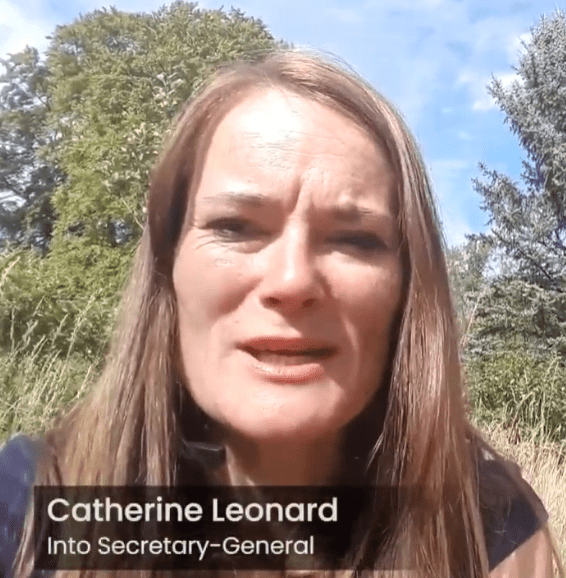
We also talked about the wider impacts of COVID-19 on the INTO family and I actually recorded a short video along similar lines for Heritage New Zealand the following day.  They had asked for a ‘Queen’s Speech’ to use in their membership mailing this month! I’m not sure I quite delivered, but tell me what you think.  Without Emma’s technical help we weren’t able to insert the images of INTO members I referred to.  And I had to film myself on my phone in the garden, but … well, that’s the way of the world these days! You can read their newsletter and check out the clip here.

Secretariat notices

So … we are very happy to welcome back Emma Taylor, our Communications Assistant, from furlough this week!  You should see some increased activity on our social media feeds (and some better, more professional content all round …!).

Thank you to everyone who joined the discussion about Reciprocal Visiting on Tuesday. I have a few 1-2-1 conversations coming up and will report back after those are completed.

Thank you too to those who have completed our sustainable tourism survey – there’s still time to do so if you haven’t yet via this link.  And there is more information about American Express’s support for INTO Antwerp 2021 on our website here.

And lastly, please join our webinar next week – more details can be found here https://ccanadaht1.com/programmes/into-webinars!

The INTO Secretariat team met at Dyrham Park

Heritage tourism is an important cultural and economic activity for virtually all INTO member organisations.  Visitors provide an opportunity for education around the cultural values of the sites.  As well as an important source of employment in the communities where INTO’s members work.

Heritage travel is increasing.  Which we might think is a good thing.  But it also poses environmental and social challenges.  Which are now coupled with the global impacts of the COVID-19 pandemic on travel and the economy.

We will use INTO Antwerp 2021 to provide lessons from our members and others in proposing pathways toward sustainable tourism in the new normal.

Project activities

Our project seeks to provide information for the heritage conservation community — along with its collaborators and stakeholders. This data will help them make evidence-based, informed decisions for the historic sites and communities they steward.   Our key strategies are:

  1. Research current issues in sustainable tourism along with current perspectives on the impacts of the COVID-19 pandemic on heritage sites
  2. Survey INTO member organisations to gather baseline information on issues such as reducing environmental impact, enhancing visitor experience, supporting local economies, protecting local cultures and traditional values, and diverting tourism traffic — where appropriate — to other, not-as-heavily-visited sites
  3. Develop case studies from INTO members and partners that relate to key issues raised in the research and survey
  4. Prepare a report to disseminate information to the heritage conservation community, along with its collaborators and stakeholders, taking information from the research, surveys, and case studies
  5. Host expert panels at INTO Antwerp 2021 to delve deeply into the issues and case studies, with follow-up reports out of the conference

Research and surveys

We are working with David Brown of Bearden Brown LLC  to deliver this project.   BBLLC has been gathering information from a variety of online and published sources about the impacts of COVID-19 on tourism.  And the longer-term issues of over-tourism on fragile heritage sites.

The first of two surveys of the INTO membership was launched late in June. As of 14 July, we have heard from 30% of the INTO membership, representing 26 organizations. Here are some of the top-line findings to date:

  • The financial and programmatic sustainability of organizations has been significantly impacted by COVID-19:
  • More than half have seen a drop in their membership recruitment and retention
  • While 35% of the respondents receive less than 10% of their annual budget from site-related income
  • More than a quarter — or 27% — receive at least half of their income from sites-related activities such as admissions, rentals, and gifts shops
  • With visitation down or non-existent during this period, those groups are seeing serious erosion of their fiscal standing since the arrival of the coronavirus
  • There are several ways INTO members/heritage organizations are working to address this financial strain on annual budgets:
  • 60% of the organisations have cut non-staff related activities such as programs, marketing, and overhead expenses
  • 40% have turned to government grants or loans
  • 12% have relied on staff reductions or furloughs
  • Before the coronavirus outbreak, visitation to heritage sites was on the rise for many of the respondents. Heritage sites are an attraction to the world’s tourists:
  • 38% of the organisations had seen increases in visitation of 1 – 5% over the past three years
  • 27% had annual increases of more than 5% – Thus, 65% of the organisations responding to the survey reported trends of increased visitation in the three years before the pandemic
  • Only a handful — some 15% — had three-year trends showing decreasing visitation by 5% or more
  • Organisations are using a variety of tools and methods to connect their work to their stakeholders and the broader public during the pandemic. The most popular include:
  • Restricting visitation to the grounds while keeping buildings closed
  • Online video tours
  • Video chats and webinars with programmatic staff

There is more detail from the responses in the comments.  However, a summary of the initial results suggests that we will have rich and useful information on both impact and best practices to share with the larger community through this project.

Reopening at Petworth House, West Sussex – Photograph by Hannah Elliot (c) National Trust Images

Case studies

This segment of the work is in its early stages and will be fleshed out with further research and survey data. BBLLC has begun to collect basic information on potential case study candidates for consideration in the coming weeks. We are also reaching out to key contacts for information, as when Catherine Leonard and David Brown held an informative Zoom call earlier this week to begin study of the impact of COVID and over-tourism in Venice.

Engagement with funder and INTO Antwerp 2021 planning committee

Since the project’s launch, BBLLC and Catherine Leonard have had three video conferences with Richard Brown of the American Express Foundation. The purpose of these calls is to update AMEX on the work’s progress to date, gather approvals for certain lines of study, and seek information and contacts that can be helpful as the project progresses.

The most recent video conference, on 8 July 2020, was held two days after David Brown joined the monthly planning call of the INTO Antwerp 2021 planning committee to update them on the project. It is expected that he will continue to sit in on these calls through the rest of 2020 and into 2021.

A blog by Catherine Leonard, Secretary-General

Reciprocal Visiting

INTO members participating in our new Reciprocal Visiting Programme are invited to join a discussion on 14 July at 12 noon UK time (11am GMT). We will review next steps and participating organisations will share where they are on the timeline.  Please join the conversation via this link.

The new arrangements between INTO members in the Isle of Man and Guernsey, which I mentioned in my last update, made it onto the BBC news this week. It’ll be really great when we can announce our new INTO-wide programme!

Reopening webinar

As many INTO members have now reopened their doors, gates and drawbridges (!), the next webinar in our series will explore the reopening experiences and lessons learned. Site managers from three European trusts will talk about the practicalities and compare different approaches, with tips that can be applied elsewhere in the world.  It will take place at 3pm UK time (14h00 GMT) on 22 July.  Please register via our webinar page.

It’s really heart-warming to see the joy of reopening in our Members’ social media feeds, here’s a few examples.

  • Like many INTO members, the National Trust for Scotland has been using social media to interact and engage with its members and supporters
  • Hydrangeas in the rain in Japan
  • An article about National Cream Tea Day (26 June, if you’re interested) spent at Sissinghurst
  • And an absolutely reopening beautiful video of the Zimbabwe National Trust’s flagship property, La Rochelle – can’t wait for those travel restrictions to end (click here for the full experience)!

Sustainable tourism survey

Many thanks to everyone who has completed our survey on the impacts of C-19 on your work and organisation.  If you haven’t already, there is still time and you can access it via this link to Survey Monkey.  We want to get as full a picture as possible of the global impacts of C-19 on the INTO family and really welcome your support.

NTEWNI calls for £5.5 billion investment in greening urban areas

This week, the National Trust EWNI has called for a £5.5 billion commitment from the UK government to invest in ‘greening’ the nation’s most deprived and greyest urban areas over the next five years.   Director-General, Hilary McGrady said the surge in use of green spaces during the coronavirus pandemic – up 25% this May compared with May 2018 – shows a desire for urgent green investment in neighbourhoods, towns and cities right across the country.  “Everyone needs access to natural beauty for their wellbeing. It’s the very foundations on which the Trust was built, and we want to live up to that ambition by supporting partners, projects and innovations that can deliver this humble but inspiring benefit to millions more people.

The idea is to transform grey side streets into street parks, upgrade poor quality parks with more trees and better facilities to make them ‘fit for the 21st century’, and create large regional parks and forests on the urban fringe to make it easier for people without a car to enjoy wild natural spaces.   You can find out more here.

Moustachioed moochers

I love this initiative, raising the profile of REMPART’s work to save and celebrate French heritage!  (And I have a bit of a soft spot for an Yves Montand chanson …)  You can follow their progress, by bike, through the most beautiful villages of France via the REMPART website.

Dogs and drive-ins

And here’s another couple of nice ideas – a sponsored dog walk organised by An Taisce in Ireland and drive-in cinema at Blenheim Palace (non-INTO).

Diversity, equity and inclusion

Next week, the National Trust for Canada will be hosting five heritage leaders, talking about how heritage organisations, heritage sites and heritage advocates can show anti-racist leadership through their programmes, practices, plans and actions.  It sounds really interesting and you can sign up here, as well as access earlier discussions on subjects like fundraising, marketing and site management.

And finally …

If you’ve ever wondered what goes on behind the scenes at the National Trust for Scotland, here are ten ways it delivers its core purpose: From grazing battlefields to preserving poetry!

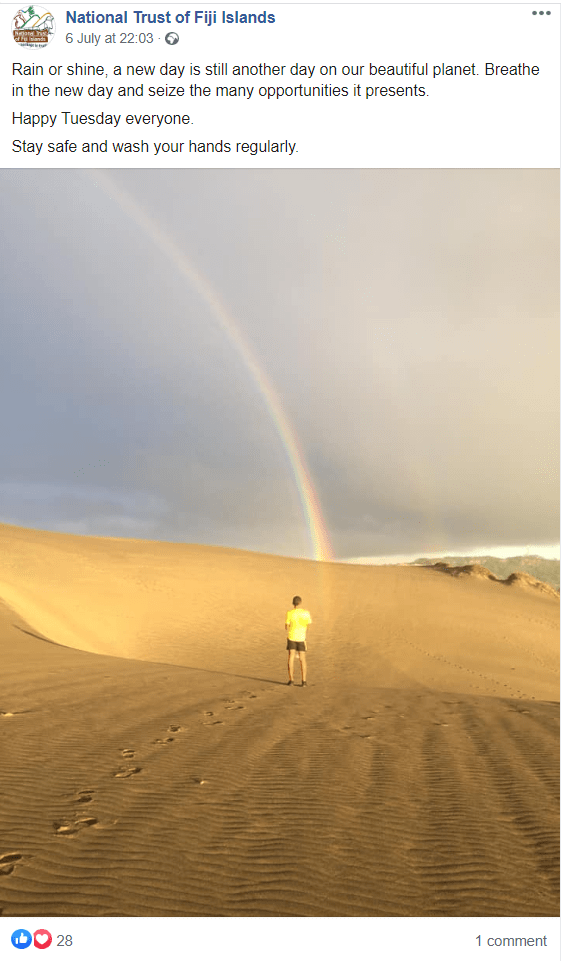
This afternoon we have a meeting of our Board of Trustees which I will report on next week.  Have a wonderful weekend, stay safe and enjoy this beautiful rainbow from the National Trust for Fiji.

A blog by Catherine Leonard, Secretary-General

This is a short update as Alex has just put together our usual monthly newsletter, which I hope you all receive.  (If not, do sign up for these on our homepage!)

I also hope you got our impact survey earlier in the week – if you didn’t, you can access it here via this Survey Monkey link – or drop me a line and I can send you further information.  We’re keen to get as full a picture as possible of the global impacts of COVID-19 on the INTO family and really welcome your participation!

Here is an article by Karin Taylor about the impacts of COVID-19 on Fiji.  Karin spent time with the National Trust for Fiji on a TAP-INTO project earlier in the year in her role as Head of Planning for the National Trust of England, Wales and Northern Ireland.  “The recovery of the tourism sector is vital to Fiji’s economic recovery following the pandemic”, she writes.  “And planning will have a fundamental role to play in how that happens.  There are already signs of pressure to encourage economic recovery through development and new infrastructure”.

Please let us know the impacts of COVID-19 on your organisation through our short survey.

Reciprocal Visiting

This week, two INTO members agreed a new bilateral reciprocal visiting arrangement!  Working at pace after the relaxation of quarantine restrictions, Manx National Heritage and the National Trust for Guernsey signed a new deal which allows each other’s members to visit for free.  Sounds like some inter-island summer holidays coming up!

It was lovely too to see so many volunteers out in force, raking the NTG’s wild orchid meadow.  I wonder whether other INTO members have seen increased interest in outdoor volunteering this year?

And don’t forget to join our wider discussion on reciprocal visiting on 14 July.  (Scheduled for 12 noon current UK time – Please use this link to attend.)

7 Historic Civil Rights Sites

Here’s an uncompromising article by Brianna Rhodes, the African American Cultural Heritage Action Fund Fellow for the National Trust for Historic Preservation.  She writes: “Activism and protests are not new to the history of the fight against racism. Leaders from the Civil Rights Movement paved the way for those who are amplifying their voices today, and significant sites across the country such as A.G. Gaston Motel and 16th Street Baptist Church in Birmingham, Alabama, continue to tell the narrative of why all Americans should continue to fight for equal treatment.

So much of our heritage is steeped in the remnants and history of slavery.  As we all try to ensure we tell the whole story, here’s an article from Edmund Southworth of Manx National Heritage about the island’s role in the Transatlantic Slave Trade.  And a moving film installation at Newstead Abbey (non-INTO) here in the UK.  Made by a local Slave Trade Legacies group, it highlights the property’s link to slavery wealth.

Reopening across the world

Wonderful to see so many more new places opening to the public around the world this week.  From Clendon House in the very north of North Island where Heritage New Zealand tells the story of tenacious Jane Clendon, widowed at 34 with eight children – to Robert Adam’s 18th century clifftop masterpiece of Culzean Castle, looked after by the National Trust for Scotland.

Special content for members

On a recent webinar with the NTEWNI, we heard about the importance of digital programming to build engagement and retain membership over the summer.  This transition phase will focus on:

  • Developing deeper value and a feeling of exclusivity, such as sneak previews for members of ‘hidden’ web content (like the Mottisfont video below, which was very successful)
  • Online content to inspire and enrich visits (additional information and activities that can be downloaded before or after a visit)
  • Optimising content and putting the right stuff on the right channel (such as behind the scenes videos)
  • Aligning with reopening to overcome capacity problems

The Great Summer Staycation will feature heavily, and content will be based on topics they know work, like going somewhere to unwind, learn, read a book, play.

Canadians love their heritage!

Canadians see their local historic places as badges of pride that reflect our nation’s diverse history and culture,” says Natalie Bull, executive director at the National Trust for Canada and INTO Trustee.  The new study, Canadians and Heritage Places, reveals widespread support from Canadians for the preservation and celebration of the country’s many heritage places, historic sites and traditional neighbourhoods.  90 per cent of Canadians feel it is important to preserve heritage sites and historic places, with 64 per cent believing that heritage sites help present the country’s collective narrative.

Europa Nostra Awards 2021

Alex mentioned this year’s edition in the main newsletter, and our European members can apply for the 2021 Awards (until 1 October 2020).  Prizes are awarded under the categories of Conservation; Research; Dedicated service by individuals or organisations; and Education, training and awareness-raising.

And in other news …

Really nice to see this partnership between the Bermuda National Trust and the Department of Education. Over 350 primary school children have been involved in online lessons and virtual visits.   And in an article about this year’s Architectural Awards, Din l’Art Helwa say “while the COVID-19 pandemic has ground to a halt many people’s lives, the restoration and rehabilitation of heritage sites and their immediate environment have continued at ‘an increased’ pace”.  That’s good news, although I know they also have concerns about the rush to build a way out of the crisis.

Stop press!

I just had a lovely email from Lin Goncalves at the National Trust of Zimbabwe, in response to our June Newsletter!  She shared a fabulous story about her mother’s best friend, Rosie who was born on St Kilda in 1909.   Having been evacuated in 1930, she travelled to Kenya as a nurse after the war, eventually settling in Southern Rhodesia, now Zimbabwe.  There’s much more to the story, which Lin is writing up into a biography.  Watch this space!   She did say that when Susie passed away, she was able to get Rosie’s ashes back to St Kilda with the help of friends from the National Trust for Scotland.

And finally …

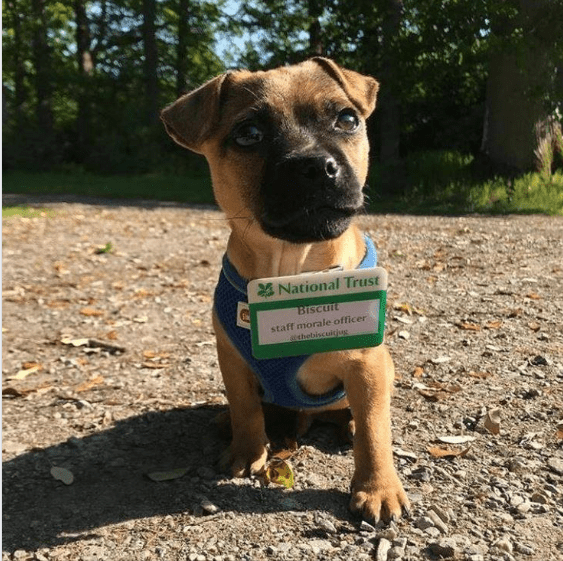
I’m in love with Biscuit, Staff Morale Officer at the Argory, Northern Ireland!


A blog by Catherine Leonard, Secretary-General

We’re beginning to process the receipts for our special TAP-INTO grants this week.  Laptops, zoom accounts, cameras, face masks, information films, Perspex screens – not particularly exciting, but all vital to our members’ recovery from C-19.  We are delighted to have been able to help in a small way.  Here is Nadia Hardie in PPE kit with the Blue Iguana Conservation gang at the National Trust for the Cayman Islands!

And we continue to offer moral support and advice via our ASK-INTO programme (simply a way to connect you to the expertise you need), our international webinar series as well as on-going communications like these weekly updates and our social media feeds.

The last webinar was led by Kara Roopsingh of the National Trust of Trinidad and Tobago and Clea Warner of the National Trust for Scotland.  They collaborated on a TAP-INTO project last year looking at ways to unlock the potential of island heritage sites.  They shared some good tips for creating destinations, working with local entrepreneurs, telling multiple and layered histories, attracting tourists whilst engaging local people and maintaining conservation standards, developing a master plan, even how to pivot retail in the time of corona!  It was a great discussion, ably hosted by Alex Lamont Bishop.

We’re grateful to them both for sharing their experiences.   These are challenging times, but it’s really heartening to see INTO members still working together, in solidarity with one another, although currently apart.

Reopening stories – Drayton Hall

I’ve mentioned Drayton Hall before in these updates – it’s an 18th-century Palladian mansion in Charleston, South Carolina, in the care of the National Trust for Historic Preservation.   And it’s at the heart of two things we’re all grappling with at the moment: how to tell a broader range of stories about our places and how we recover from coronavirus.

As Cat Coughlin, Communications Manager says in this article about Charleston, “There is a new inclination to lean into harder discussions here. No gloss. You can’t put lipstick on this story. But it is the American story. We have a responsibility.”  And this is echoed by John Orna-Ornstein of the National Trust for England, Wales and Northern Ireland in an article this week about the links of British country houses to slavery.

Secondly, Drayton Hall embodies the way so many INTO places are working through coronavirus.  First, they took their work online, like offering this virtual tour of the attic, an area usually off-limits to visitors, during the National Trust’s Preservation Month. Then they opened for landscape visits.  And yesterday they began reopening the main house.

Digital culture

But whilst we are beginning to reopen our houses and reconnect people with actual places, the progress on digital access we’ve made over the past few months will serve us well post-corona.  “We’ve opened up, tremendously, ways in which people experience historic places digitally in the past eight weeks, and I think that’s here to stay,” says Katherine Malone-France, Chief Preservation Officer at the National Trust for Historic Preservation and Trustee of INTO, in this article about the future of preservation. “This wave of digital creativity is going to have long-term benefits for all aspects of the way we think about heritage and place-based tourism.”

Improved access and communications make our work more participatory and more focussed on the people we are here to serve. Which can only be a good thing!

Annual Reports

We’ve had some great feedback on our 2019 Annual Report from our wider stakeholder network.  Like this from Dr Shobita Punja, art historian and former CEO of India’s National Culture Fund: “It’s amazing how far your reach is and how you are expanding activities to meet local needs.”  Or this from UNESCO specialist, Richard Engelhardt, who spoke at INTO Bali 2017: “I read it with interest and felt encouraged at all the new innovative programmes INTO members have managed to launch.”

The video was particularly well received. “Thank you so much for this cheering film and report! It’s really given me a lift to see how far you’ve come and to reconnect with old friends”, said Judy Cligman who spoke at our Delhi conference when she was Policy Director at the UK Heritage Lottery Fund. And I’ll let you into a little secret … as our Communications Assistant is on furlough, I made it myself on animoto.com

Sharing our Report has prompted some INTO members to share theirs with us, which is lovely.  Thank you.   This week, we received the 2019 Rapport d’Activité from the Conservatoire du Littoral.  I particularly liked reading about the demolition of the last villa of the Rémire-Montjoly holiday camp in French Guiana, which is now happily returned to nature.  It reminded me of the National Trust for Jersey’s similar work at Plémont, which we featured in our 2015 case study series.

Reciprocal Visiting discussion on Tuesday 14 July

I jumped the gun with my email last week – my apologies.  We are going to hold two separate events now. The first focussing on the logistics of the Reciprocal Visiting Programme on 14 July, and a second exploring wider engagement issues.   If you have signed up for the RVP – or are considering it – please join the online discussion at 11am GMT (12 noon current UK time) on Tuesday 14 July on zoom.

Valiant volunteers

Over 1000 volunteers have returned to NTEWNI properties this week.  General Managers and Volunteer Managers across over 140 places have been carefully following guidance to welcome volunteers back on site.  This still represents a small proportion (average 8 per place) but is great that they can now support essential and reopening tasks.   If you would like to learn more about how they are managing this, please do contact me.

Visitor welcome assistant at Coleton Fishacre, Devon

Europa Nostra Awards – Congratulations and call for entries

As proud partners of Europa Nostra, we were delighted to see the Friends of Czech Heritage, an INTO associate, shortlisted this year!  They are up for the Ilucidare prize, which showcases outstanding examples of heritage-led innovation and international relations around Europe.  Congratulations!  Europa Nostra is now calling for entries for the 2021 edition.  More information about the awards, including how to apply, can be found on the Europa Nostra website.

A blog by Catherine Leonard, Secretary-General

I’ve had some really nice feedback from members about these updates so I’m going to keep sharing them for the moment.  A bit less on the reopening front today so I’m including that in the body of the email.  But do please send us your news – maybe add us to your press release mailing list?

As I’m writing this, I’ve just seen that the US National Trust has issued a statement on Confederate monuments, which can perhaps be read alongside the NTEWNI’s similar on addressing the histories of slavery and colonialism. These are useful pointers as we all seek to live through our values, educate ourselves and reflect on our role in telling the full story.

Channel Islands reopen

We were all delighted to see that the National Trust of Guernsey reopened its Folk and Costume Museum on Monday!  And are also taking bookings at their 18th century watchtower:

Last Friday I had a good chat with Charles from the National Trust for Jersey about their plans to open the Wetland Centre later that day.  I think we’re all familiar with the sanitary and distance rules now, so I won’t detail those here. But it was interesting to hear his concerns about volunteers, many of whom are in the vulnerable category.  And that they will potentially lose money by reopening their sites, although very important for morale to do so.   Charles also reported that membership has remained steady thankfully, as has rental income.

Tip: They sent postcards to all their members, thanking them for their support.  The vast majority were hugely thankful as many are not on email or social media.  Other Trusts have been talking about price-freezing or reducing membership fees as a simple way to say thank you (and increase retention).

INTO online discussion on attracting local audiences – 30 June

Like many Trusts, Jersey is looking at ways to engage local audiences.  And on that note, we will be holding an online discussion for members involved in the RVP on 30 June at 12 noon UK time (GMT+1) to talk about engaging with local users and programming post-corona.  More information to follow but please register your interest here.

Dutch castles

As I mentioned last week, the Gelderland Trust has also reopened some of its indoor sites, with more to come this weekend.  Jeanine told me that everyone is thrilled, apart from the many volunteers who still have to be shielded.  They are itching to return.  And the Trust would love to have them, as they provide lots of daily support with housekeeping and gardening, but mostly because they are part of the family, and are sorely missed.   But health must come first.

They have also turned to technology for bookings and information.  Lots of QR codes – to download room ‘fact sheets’ and even to buy a ticket on site.   They have worked hard on new routes around the castles to avoid overcrowding.  Where it’s not possible to ensure social distance, one castle has even installed a traffic light system!

These investments are costly however and, with less visitors, no events, reduced rent from café/restaurant partners, finances are stretched.  But Jeanine said that fundraising continues, and an exceptional number of visitors have become new donors to the Trust!  Also, the Dutch national airline KLM has a campaign to support culture during corona, so they now have 28 air stewards working from them!

As I mentioned last week, the National Trust EWNI is reporting good membership recruitment and increasing the amount of bookable tickets to its properties.  The National Trust for Scotland’s fundraiser is also going well.   And our colleagues at Heritage New Zealand are seeing the travel ban as an opportunity to increase local tourism.

More to see on the Isle of Man

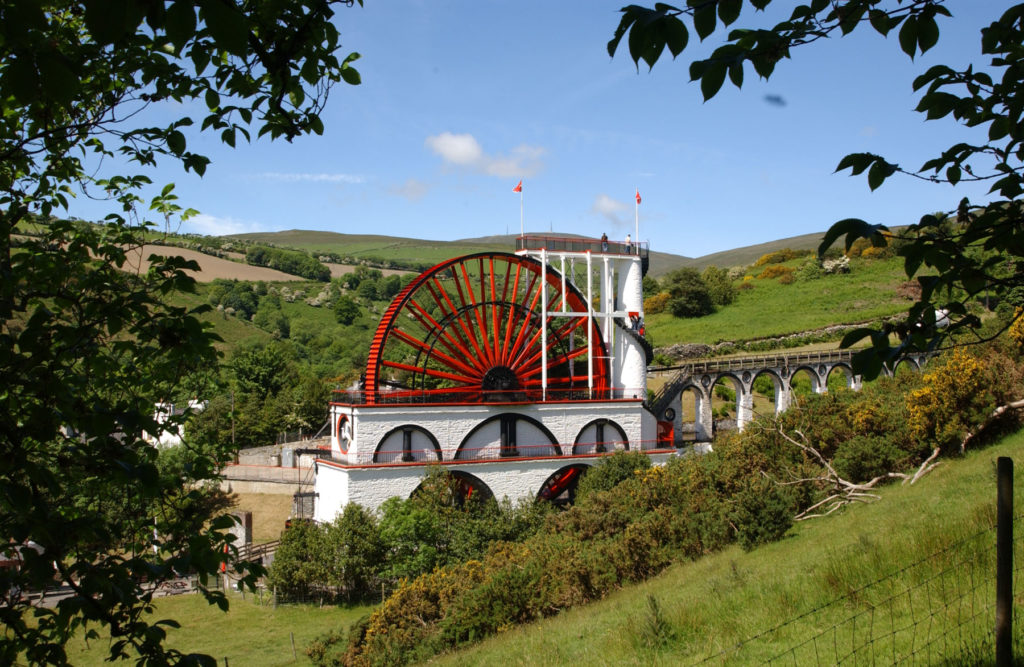
Hot on the heels of Peel Castle last week, Manx National Heritage opened Rushen Abbey and the Laxey Wheel yesterday.  As social distancing measures have been reduced, the interpretation centre and heritage shop are also open at Rushden Abbey, as well as the gardens.  And people can climb to the top of the Laxey Wheel. Toilets are also now open.  They did report some vandalism at Peel Castle however where new signage was removed.

There have been a few instances of littering and deliberate damage – if you have any tips on how to handle this, do please share!

Sign of the times

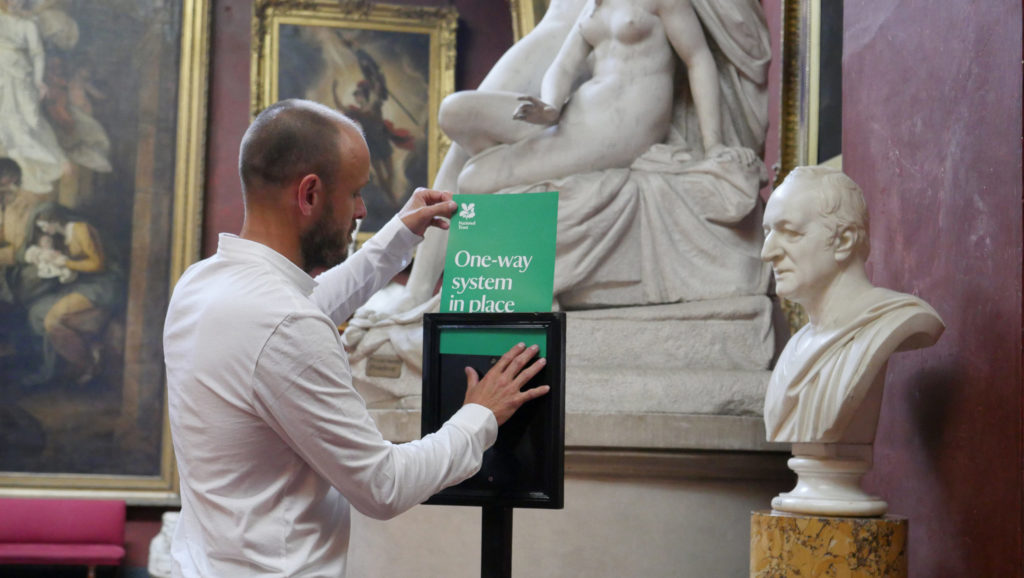
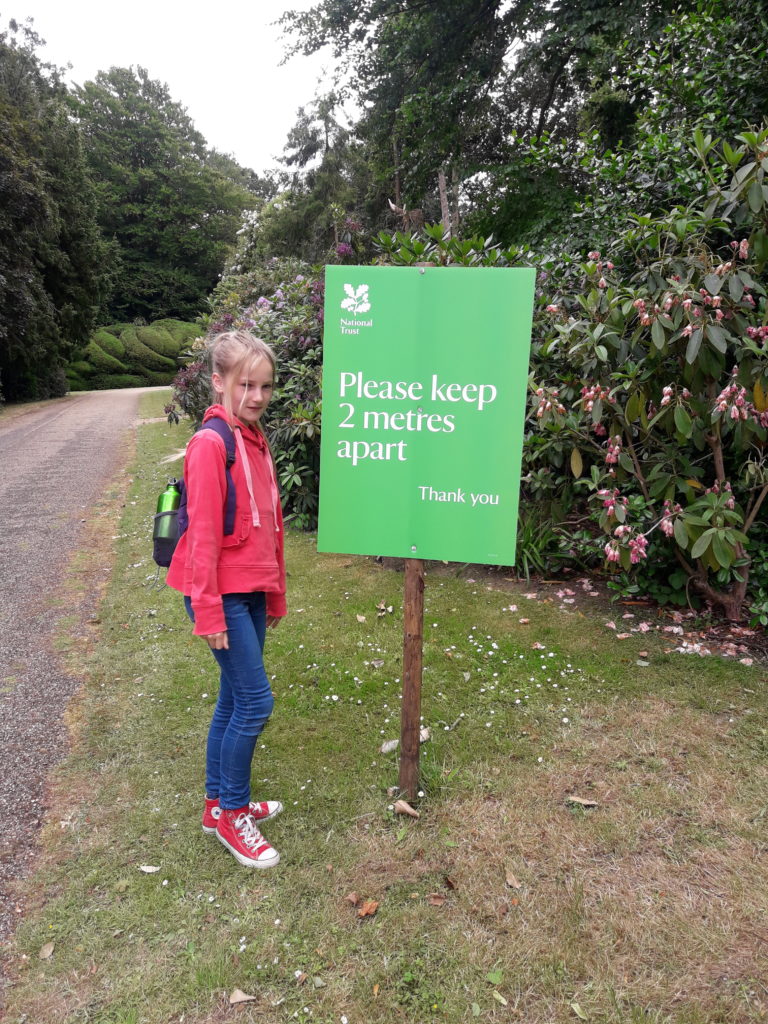
Interesting to hear that INTO members are already beginning to modify their signage and tone. The NTEWNI is updating its templates and new signage will say “Keep a safe distance apart’ for example as we wait for government guidance on our (current) 2m rule.

Outdoor days – Giornate FAI all’aperto

FAI will hold its famous ‘Spring Days’ next weekend.  This is usually a very important fundraising and member recruitment event at the beginning of the visitor season. FAI is hoping that this outdoors, pre-booked (and donated) version will help fill the gap.  (For info, FAI are using Musement as their booking system.)

Webinars, webinars everywhere

Like everyone, I’ve been to a lot of webinars and online discussions this week, including an excellent one yesterday about the shape of the future run by the Association of Independent Museums.  John Orna-Ornstein of the NTEWNI was one of the speakers and I was struck by what he said about focusing on our users and what they want from us as organisations.  As well as the importance of partnership.

We also had a good partner meeting of the Innocastle project as we work out how to take more content and learning online.  We will certainly be feeding in some good practice from the INTO network in managing heritage post-pandemic:

And lastly some interesting tips from the National Trust for Canada’s discussion about the impacts on urban heritage and revitalising Main Streets after the crisis.  There is a recording of the webinar here.

2019 Annual Report

A reminder that this can be found here as an e-book or as a download from our website or condensed into a 1-minute video here!

At the weekend, I joined the REMPART General Assembly, online version.  Normally it’s a three-day affair bringing together their partners from across France.  But they bravely took it into the virtual space this year and it worked very well.  It was good to feel their passion for heritage, for partnership and for social inclusion across the airwaves. Whilst there’s no substitute for a live experience (as we know from our work), it does show us that we can act and interact differently.  (And thank you for the shout out to INTO!)

In a discussion with Interreg Europe partners on digital technology, we considered which of the resourceful adaptations and innovations we’ve made over the past months will remain with us into the future.  Many, like online meetings, operating at pace, developing new skills and increasing engagement through online content, have been very positive.  And we will all want to want to build on those as we review our mission and purpose on the road ahead.

Do reach out to us here at INTO if there is anything we can assist with.  We need good networks more than ever at the moment.


A blog by Catherine Leonard, Secretary-General

In an effort to keep these updates concise, I am linking again to our round-up of reopening stories on the INTO website.

Out and about

So, it’s Friday again and I hope this work week has gone well for you.  I had my first excursion to a National Trust place this week, which was truly wonderful. Just an hour or so in the beautiful garden at Hinton Ampner, the nearest to my home.  But lovely to be reminded of why we do what we do. I tweeted some ‘pretty pictures’ here but I’m sure you’re all more interested in the NT EWNI’s signage and messaging …

Love in the time of corona

Fundraising is a big focus in INTO members’ renewal plans.  Certainly, the NT here is ramping up its giving messages and launched its first national ‘text-to-donate’ appeal to coincide with reopening quickly pulling in 412 gifts just from car park signs (see above).   And a new donate button on the top navigation bar of the website has also worked well.

Talking more about ‘cause’ (rather than membership offer and proposition) is like turning an oil tanker (if you’ll forgive the inappropriate simile).   But we’re all having to be more like speed boats at the moment!  The National Trust for Jersey has rejigged its ’30 Bays in 30 Days’ fundraising initiative to fit in with government guidelines:

I received a postal appeal this week from the National Trust for Scotland.  The message is simple.  “We need your help today to make sure we can continue to look after the places we all love.” If every home that has an NTS membership gives £14, they will raise their target of £2.5m. 

And yesterday, I had an email from Pro Patrimonio in Romania.  With the help of pro-bono developers, they have established a new mobile-first fundraising platform.  This allows the public to select a project to support and give through a simple, secure online giving page.

Virtual Visits

Every May, the US National Trust for Historic Preservation organises ‘Preservation Month’.  This year, with the help of the American Express Foundation, they held a successful virtual version.  I know May is over but there are some great experiences and ideas still available here.  I particularly enjoyed this concert from Nina Simone’s childhood home. 

On that note … I hope you have a safe and pleasant weekend.

A blog by Catherine Leonard, Secretary-General

It’s Friday again!  And we’ve had another good week at the INTO home offices.  I’ve particularly enjoyed reading the responses from our Covid-19 TAP-INTO grant recipients.  We were delighted to be able to make awards to INTO members from Fiji to Zanzibar, Saint Lucia to Jordan.  And here are a couple of their replies:

“To be able to reach out to INTO for assistance at this time is wonderful. One of the silver linings of the pandemic has been the sense of community and support in the voluntary sector and INTO has been at the forefront in this area.”

“In the moments like this one is reminded how blessed we are to be part of a caring and supportive INTO family.”

Those really have made my week – thanks to all of you for your support and everything you do for people and places around the world.  INTO wouldn’t be INTO without you!

Reopening our places

I’m separating out our reopening update this week which you can download from the INTO website here.

Some lovely images, ideas and feedback. Particularly from FAI, who’ve now had their second (long) weekend of opening, the Trustees of Reservations and the National Trust of England, Wales and Northern Ireland, which opened 29 gardens and parklands on Wednesday.  Well done everyone – the feedback from your supporters looks amazing!  All that planning, preparation and hard work has really paid off.

Celebrate Islands

On Wednesday I had the honour of chairing a Celebrate Islands webinar involving several INTO members.  Organised by the Conservatoire du Littoral and their partners, our webinar brought together voices from the Americas and Europe to share experiences as we seek to strengthen island resilience.   We heard some good practical solutions for getting ready to reopen and reengage after the pandemic from the Cayman Islands National Trust.  With a focus on being flexible, ready and proactive.

The Saint Lucia National Trust has been developing creative solutions and growing virtual engagement amongst its members and supporters.  Online events themed around environmental observances, like Earth Day or World Turtle Day, have provided opportunities to share conservation messages.  Both organisations talked about redeploying staff, learning new skills and sharing responsibilities.

The lack of tourists is impacting all our islands, which was echoed by the National Trust in Wales, where island communities like Anglesey rely heavily on visitors. We heard that nature is coming back (something also observed in Saint Lucia) and people are noticing it more too.  Coronavirus is offering us an opportunity to rethink as individuals, communities, organisations and even whole countries.

All in all, it was an interesting discussion and we’re very grateful to the organisers, speakers and participants!  (There is a summary on our website here and the recording will be available shortly.)

INTO Annual Report 2019

In case you missed it in the newsletter last week, here is our 2019 Annual Report (glossy version).  Flicking back through it, I’m reminded of all the travelling and connecting we normally do here at INTO.  How times have changed …

Holding a virtual conference


Many INTO members are taking their work and programmes online this year.  We are still planning to go ahead with our INTO Antwerp 2021 conference (and in fact had a project meeting with our hosts and steering committee yesterday) but for those of you who’d welcome some ideas about holding a virtual conference, why not take a look at this advice from Interpret Europe, the European Association for Heritage Interpretation?

#TellTheFullStory

Lastly, I urge you to read these statements from the National Trust for Historic Preservation on the Death of George Floyd and the aftermath, and In response to protests at Washington, D.C.’s Lafayette Square.

Here’s a quote from Paul Edmondson’s statement: “We believe that historic preservation can play a critical role in acknowledging and healing the divisions in our nation, by telling the full story of our often-difficult history, by elevating and preserving the enormous and important contributions African Americans have made to our nation, and by carrying that powerful legacy forward through places of truth and reconciliation.”

We are all so saddened, but this is not just something that’s happening in America.  We all need to tackle inequity and injustice, wherever we are in the world.  And how I do that in my life is something I’m going to be reflecting on over the coming days.

A blog by Catherine Leonard, Secretary-General

So, another week has gone by and I’m here with my Friday update.  In many countries, we’re beginning to see a gradual flattening of the curve, the easing of restrictions and even the opening up of some heritage sites.  But we’re also seeing INTO members facing big challenges and big questions about the future.   I hope that wherever you are in the world, this email finds you well.

Let’s reopen the doors!

Last weekend, FAI – Fondo Ambiente Italiano (the Italian National Trust) reopened the doors of 30 properties. Check out some highlights below, and this lovely video shared on their social media:

  • More than half the number of visitors compared to the same weekend last year
  • Most popular sites were close to cities and with open air spaces, parks and gardens
  • 60% visitors paid in advance online, 10% were members
  • Reduced visitor numbers mean that staff can have longer conversations with visitors, which has had a positive impact on both new memberships and renewals!

Opening the gates in England, Wales and Northern Ireland

The National Trust EWNI has opened 200 of its coast and countryside carparks.  They are all very busy and a bit of a challenge but better than being closed and roadsides filling with parked cars!  There are ten bookable carparks, which are working well.

On 3 June, the NTENWI will open a small number of pay for entry parks and gardens.  (No buildings or indoors spaces at the moment.) Places need to be booked online, in 30 minutes arrival slots with numbers spread throughout the day.  In fact, advance booking is going to be necessary for the foreseeable future.  They plan to open 30 new properties a week, initially at 30% normal visitor capacity.  Food and beverage will be trialled slowly and more ‘grab and go’ facilities developed.

The NTEWNI is emailing members weekly to keep them informed and engaged off-property, whilst also encouraging to book visits.

Testing group visits at a Czech castle

Yesterday, our colleagues at Kroměříž  Castle in the Czech Republic opened their doors for guided tours for the first time.  Previously they had opened on a free-flow basis and welcomed 3,000 visitors over two weekends. But they only had 20 people sign up for a tour yesterday, when normally it would have been between 200-400.  Perhaps joining a group of unknown people is too much at the moment?

Is it OK to fundraise?

We hear that many INTO members are working on major new fundraising campaigns. These are complex decisions given the current (and appropriate) focus on health.  Fundraisers are highlighting public benefit and the importance of our work to people’s wellbeing: Providing safe spaces for families to come together – or simply to enjoy beauty and tranquillity.  Grant writers are stressing the importance of heritage surviving the crisis.  At a basic level, not falling into disrepair or being demolished (see below).  But more than that: Special places and creative industries helping fuel a green recovery, with an increased emphasis on the importance of local attractions.

Let’s not build or demolish our way out of the crisis

We heard this week about the destruction of the oldest building in Saint Lucia, the Royal Old Gaol, and our colleagues at the Saint Lucia National Trust have asked you to share the story with your networks.  Here is their facebook post.

Sadly, this sort of thing is happening all over the work, with development and construction continuing unabated.  Many National Trusts are calling on their governments to learn from the lessons of lockdown (cleaner air, changed behaviours, importance of culture and nature) and prioritise solutions like the reuse of old buildings, new green jobs and extra funding support for charities in the cultural heritage sector.

Reciprocal Visiting Programme

Progress on our new RVP paused in March, but we are about to pick up the reins on this again.  Everyone wants something hopeful to look forward to next year!  We will be contacting INTO members who have signed up next week.

We are also preparing a survey on tourism and the impacts of coronavirus – we hope you will be able to help with this research!

Celebrate Islands Webinar

And lastly a reminder that we are partnering with INTO members, the Conservatoire du Littoral, on 3 June to ‘Celebrate Islands’. We’ll be joined by the National Trusts of the Cayman Islands, Saint Lucia and England, Wales and Northern Ireland, who will talk about ways to strengthen island resilience.  More information can be found on the Celebrate Islands facebook page.

That’s all for now.  If you have anything you’d like to share with the INTO membership, do please email it over!

A blog by Catherine Leonard, Secretary-General

As usual, I’m sharing a brief update from us here at INTO.   It’s been a week of International Days!  Yesterday was World Day of Cultural Diversity, which many of our members celebrated.  We shared our ‘We are INTO’ video, which performed well on social media.  It made us think that we could do another version with more footage from more members … Watch this space!  (And here is also the Petra National Trust and CCFU celebrating International Museums Day on 18 May.)

World Biodiversity Day

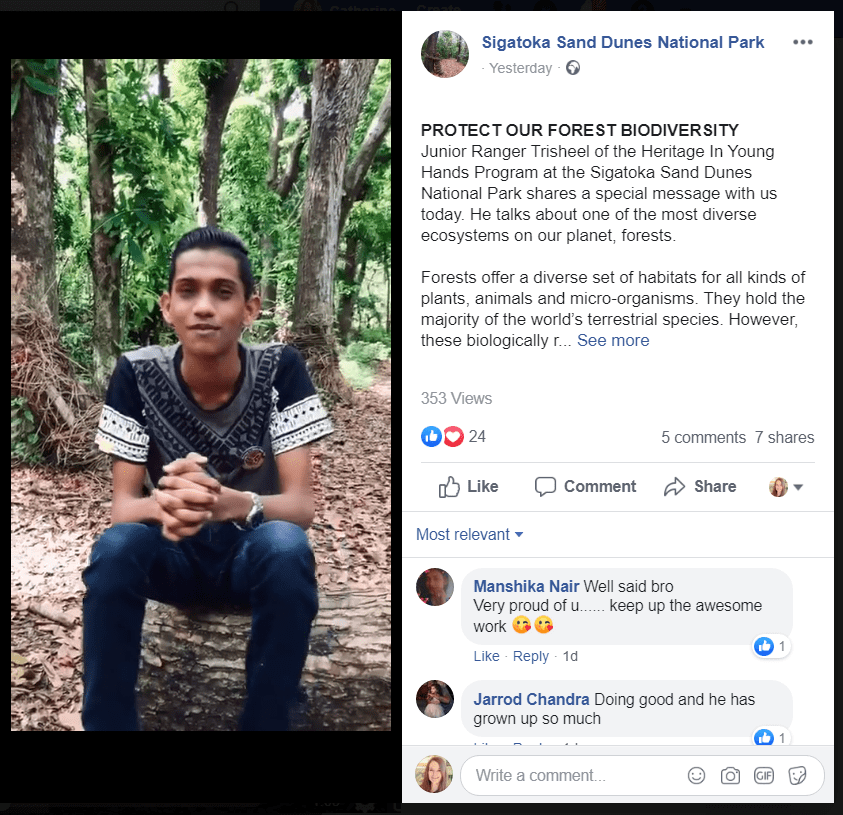
And today is World Biodiversity Day.  One of the hallmarks of National Trusts is that they look after built and natural heritage so many INTO members are marking this UN International Day as well. And today I’m featuring the National Trusts of Fiji and Saint Lucia, and the Cross-Cultural Foundation of Uganda as they’ve all be very active on social media.  Here’s a lovely video from a Junior Ranger in Fiji and a calming scene from Saint Lucia (and a National Trust for Jersey Ranger too I’ve just seen this morning):

National Trust leadership

Our National Trust leaders have taken to the airwaves this week.   Here are Elizabeth, Bishnu and Emily doing their thing on social media, TV and webinars respectively:

I found the history of the Saint Lucia National Trust particularly interesting. The Trust was originally created to safeguard Pigeon Island when it was threatened with high rises and condominiums.  There will always be a tug-of-war between development and conservation, says Bishnu, and the National Trust helps maintain the balance.  The Trust was conceived as an organisation with minimal government control, that would protect for future generations “those elements of our existence that remind us who we are and where we came from”.

Reopening plans

And lastly, in other news this week – We still want to hear your about where you are with reopening your sites. Please share any documentation you have, like this new REMPART manual, prepared to help their members welcome visitors and volunteers whilst respecting the new sanitary rules (including museums and site visiting by individuals and groups and restoration work as well as working holidays).  Or these guidelines from the Czech National Heritage Institute.

REMPART have joined a communication campaign aimed at inviting people to stay at home this summer and visit the country and its natural and cultural sites.  It’s called #CetEtéJeVisiteLaFrance and is being used across the tourism and heritage sectors.  What a great idea!   REMPART have integrated the campaign as well, with an additional slogan “Cet été je fais un chantier”:

We published three new good practices as part of our EU project.  These are based on the National Trust of England, Wales and Northern Ireland’s experience with digitising historic collections, social prescribing (heritage is good for your health!) and collaborating with the National Lottery.   Links to these can be found on our Innocastle page.

Webinars …

Last night, we hosted a webinar on planning that was attended by 20 representatives of INTO member organisations. The team will be sharing highlights but do email us if you would like to see the accompanying training notes.   What stood out for me was the shared challenge INTO members are facing as governments try to build their way out of the coronavirus crisis.  And how we need to build the case for heritage as part of post-corona recovery.

Talking of webinars, we are partnering with INTO members, the Conservatoire du Littoral on 3 June to Celebrate Islands!  We’ll be joined by the National Trusts of the Cayman Islands, Saint Lucia and England, Wales and Northern Ireland.   More information can be found on the Celebrate Islands facebook page – we hope you might join us!

Covid-19 grants

Thanks to those who applied for a C-19 TAP-INTO grant. Due to the very high level of interest, it will take us slightly longer to confirm whether funding is available but we’re aiming to get back to everyone next week.

Lastly, Alex and I have been catching up on reports this week, including our first-year grant report to the Helen Hamlyn Trust.  We’ve created an infographic showing the beneficiaries of the grant (below).

Some of us are off on Monday for another long weekend – whatever you are doing, I hope you find something beautiful to relax with!


Close up view of the dresser in the Kitchen in the basement at Uppark, West Sussex. Containing blue and white china, copper moulds and saucepans.

Digitisation of cultural heritage can be a crucial tool in today’s efforts towards the conservation, study and promotion of European cultural resources.

Collaboration with the Lottery was one of the specific practices identified by the Innocastle team on their study visit to the UK in May 2019.  The ‘good practice’ is available on the Interreg Europe Policy Learning Platform with additional resources here on the INTO site.

Readers directed here from the Interreg Europe Policy Learning Platform – please scroll down for a selection of resources.

Creating an online curiosity cabinet: Digitising historic collections

From fire and flood, to war and neglect, cultural resources are under threat all over the world.  Recent blazes at Notre Dame and the National Museum of Brazil have highlighted the need to record this unique heritage for future generations.   And conservation experts are increasingly turning to digital technology to document the unique artefacts, monuments and sites in their care.  This not only supports any future restoration challenges, but the digitising cultural heritage also increases public access.

The National Trust began work on digitising its fabulous collections (over 300) about twenty years ago.  In partnership with the Royal Collection, the Trust created and installed a new system in 2009.  Hundreds of staff and volunteers across the UK now use it daily.  And in December 2011 the Trust launched the Collections website, providing vital public access to over 1 million online items.

Data were first captured locally, taken from the Trust’s traditional inventory cards.  Staff and volunteers added new digital photographs and checked, marked and counted each item.   Eventually all the entries were merged into the one new system.

Each National Trust collection is different, a personal creation reflecting the lives and characters of individual people.  Now we can begin to see and appreciate the collections held by the Trust together, as a vast National Trust online museum, through which we can chart developments in taste, technology and society from the 16th century to the present day.

A school webex session at Sutton Hoo, Suffolk.

Potential for learning transfer

The project is far from over and the National Trust plans to continue gathering new information and stimulating new research. Thus each phase of the project has provided insights and information which could be shared with others around the world.

The C-19 pandemic this year has seen cultural venues everywhere take their work online. Since the start of outbreak, visits to the Paris Louvre’s website have exploded, going from 40,000 to 400,000 per day.

Thus when its properties closed, members of the public were still able to explore the collections in the Trust’s care.

Through articles and virtual exhibitions to social media posts about writing letters, spring cleaning or celebrating VE Day, the Trust’s accumulated know-how in using this vast online resource has great potential for transfer. Along with it’s experience of virtual content driving actual visits. (The Trust had 263,000 visitors to its website over Easter, compared to 753,000 last year when its properties were open.)

Resources

National Trust Collections: ‘Are you really going to count all the teaspoons? And just how many are there? Where is the Trust’s oldest teapot? Will I be able to look up all the Trust’s treasures?’ These are just a few of the questions I have answered over the past 15 years about the project to digitise the National Trust’s fabulous collections. Now, a search on this website www.nationaltrustcollections.org.uk can answer these and all your questions on objects to be found at the one-time homes of the famous (such as Agatha Christie), the aristocratic and the working class. Here you will find records of over a million objects, from laudanum bottles to a pair of Aertex underpants, sedan chairs to an early anti-ageing ‘rejuvenating’ machine, fine old masters to a lavish Georgian doll’s house.   The National Trust hopes people will use its online resources to explore the collections in its care.

(This is taken from an article, The Online Curiosity Cabinet in which Head of Collections, Philip Claris explains the work of digitising the National Trust’s collections.)

Virtual visits: See the world’s sites from your sofa!  We have gathered together 14 virtual visits, selected from amongst INTO members’ World Heritage Day posts.  They shared drone-shot footage, online tours and virtual walk-throughs that together show how heritage trusts globally are responding to COVID-19.

National Trust Images: You can also visit the National Trust’s online photo library here.

The Story of Easter Eggs in the National Trust Collection: As we celebrated Easter in lockdown this year, the Trust shared some of the many eggs in its collection on its website.  It was a very popular post.


A blog by Catherine Leonard, Secretary-General

We’re all learning how important communicating is at the moment.  Which is probably not the best way to start a blog, as I may have just massively raised expectations!  But here is some news from our members and some useful tips I learned during three webinars this week.

Furthermore, I wanted to remind full members who haven’t already applied for a TAP-INTO small grant to do so before this Sunday (17 May)! Funds are available to cover unexpected new costs associated with the Covid-19 pandemic. The maximum grant is £2,500 and there is more information here.  We look forward to receiving your proposals!

News from our network

After all the discussions over the past weeks, some summarised in this blog, National Trusts around the world are beginning to reopen their sites to the public.  Our members have really appreciated the opportunity to share learning and experiences with each other as they work there way through this unprecedented period. “I have to thank you for the way you connect the world during this crazy period! It is comforting and inspiring to hear about the experiences of other NTs.” said Jeanine Perryck of the Gelderland Trust.

Communicating to your supporters

For me, it’s really interesting how INTO members are communicating their messages to the public.  Here’s what the Trustees of Reservations say on their website: “We know how important it is to get outside, get exercise, and connect with nature in challenging times, and we will continue to work on expanding access to our special places while balancing the need to flatten the curve and slow the spread of this serious virus. Please check back for regularly for announcements on newly opened properties.”

Forming the narrative

And the National Trust of England, Wales and Northern Ireland mailed it’s members with the following: “It’s seven weeks since we closed our gates to help stop the spread of coronavirus. We’re so grateful to you and all our members for your kindness and support during our closure: from simply keeping up membership to paying virtual visits and sending messages of goodwill. It’s a brilliant reminder of what a strong community we are together. We know you’re as keen as us to get back outdoors and to all the Trust has to offer. We’re busy working out how to make it as easy as possible for you to visit your favourite places, and stay safe.”

It’s a message that’s designed to acknowledge people’s desire to get back out into nature.  But to give audiences reassurance that we are looking forward to re-opening, and that we will do so safely for visitors, staff and volunteers.   And this is echoed by our members in València, Fundem, who are communicating that there is “no better time to discover the garden than the spring – nor a better place to regain contact with nature”, as they plan to reopen on 25 May:


Communicating in challenging times

Like many of you, this week I participated in lots of online meetings and webinars!  It’s great to keep communicating but I know some people are suffering from webinar-fatigue.  And, whilst they are a brilliant way to stay connected at this time, I do sometimes dream of a handshake or kiss, a shared coffee and maybe even a National Trust shortbread!  Then I remember how difficult it is to book a meeting room and order catering in our office …  (NT shortbread was very popular amongst delegates at INTO Cambridge 2015 – click here here for a nostalgic recipe!)

Finally, I’d like to tell you about three webinars I joined this week.  Firstly, one hosted by the International Coalition of Sites of Conscience, entitled “Create Your Own Media: Communications Strategies for Challenging Times”.  They shared some good practical tips about communications in general:

  • What is the problem you’re trying to solve?
  • How to distinguish your site? What is special about it?  Why’s it necessary?
  • What do you want people to do after they leave your site?  How are you communicating that?
  • How to use “Share your thoughts” boards/notes or questions like “Have you ever broken the law?” (see the BBC article below about the Eastern State Penitentiary in Philadelphia)

The team also shared some good tips on the use of social media.  A recording of the webinar is available online and you can watch it here.

Live online training

Secondly, appropriately enough, a webinar on online training.  This was organised by the Association of Association Executives and can be watched here.  The content was focussed on the delivery of CPD.  I know this applies to some of our members, but not all.  However, there were other useful tips on webinar planning and usage:

  • Programme and spread out the learning – a two day, in person course will take weeks to deliver virtually and not all of it will be in the online classroom (other elements include self-study, learning journals, videos)
  • Make full use of the features of your webinar programme like break-out rooms, the whiteboard, chat or reactions
  • Learn how to remove someone from your webinar if your security measures fail …
  • Get a cable to your router if you’re running a webinar and don’t rely on wifi!

Busy in other ways

Lastly, this week was meant to be a busy week for us here.   We were due in Flanders for the last study visit of the EU-funded Innocastle project.   We were welcoming the Directors from Gelderland to the Lake District.   Moreover yesterday, we were all supposed to be at Buckingham Palace.  To celebrate 125 years of the National Trust (EWNI) and how it has inspired a worldwide family of Trusts.

So, I had my own garden party yesterday with my Granny’s best china (see below), the Dutch Directors will visit next year and we had the first of our online study visits to Flanders yesterday.

Innocastle inspiration

We heard interesting presentations from the Flemish state organisations, on both cultural and natural heritage.  Marc de Bie from the Flanders Heritage Agency spoke about how they were integrating landscape into their work through the Immovable Heritage Master Plan model.   I particularly loved what they were doing in the Province of Limburg to encourage stakeholders and local communities to develop nature friendly orchards.

Griet Celen of the Flemish Land Agency spoke movingly about how the countryside is covered in concrete (now 16%) and their desire create and improve open spaces.  Both stakeholders talked about cross-sectoral, collaborative processes, which was very inspiring.

But we saved the best til last!   Paul Lambrechts finished the webinar with a passionate story of volunteer efforts to save Heers Castle in Limburg.   The 16th century castle is collapsing.  The elderly owner is happy to sell, but there are legal, inheritance and debt issues.   Local people are eager to get involved.   But time is running out.  A team of volunteers has got together to try and bring the property back to life.  To give it new significance and reconnect it with the village.   They have already made much progress on clearing the surrounding parkland, which they have plans to open to the public.   But the castle itself needs completely restoring.  And no one has the sort of money required.  (In fact, the team at Heers are already also exploring crowdfunding ideas like Dartagnans.)

A different approach

What I really liked about Paul’s presentation was that they are looking at “different and cheaper ways of saving it for future generations”.   It made me think of the Transylvania Trust‘s work to restore Banffy Castle whilst training local people in restoration skills.  And of REMPART‘s work to deliver restoration work through volunteer workcamps, with a strong ethos of social benefit.  Or even the work of the Czech National Trust at Rožmitál and the Tomb of Marie von Ebner-Eschenbach.   These projects all focus on heritage as a community asset, owned and run by and for local communities.  (This is also the theme of Innocastle’s sister project, Open Heritage, under Horizon 2020)

Rather than throwing millions of euros at the project, so much can be achieved with smaller amounts of money, donated services and volunteer muscle.  Moreover its effects are often much more long-lasting in terms of local community buy-in or skills development or social welfare.  This feels like a radical return to the basic principles of our movement.  125 years on, Octavia Hill and the founders of the National Trust would have understood the volunteers at Heers Castle!

I hope you have a good weekend and week ahead.  Should you have any spare time and you’re feeling creative, why not think about submitting an entry to our partner INTBAU’s Virtual Exhibition?   Stay safe and well.


Translate »